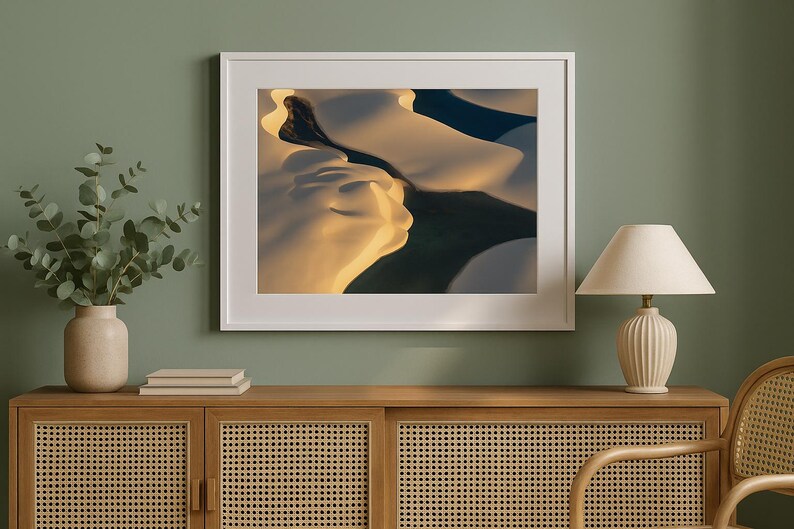
Photographed from the air over Lençóis Maranhenses in northern Brazil, where seasonal rain fills the gaps between dunes and turns a desert into a field of lagoons for a few months a year.
From above it stops reading as landscape and starts reading as pattern: wind on one axis, water on another, and the light doing the rest.
None of this is a sales pitch. It is the advice given to anyone who asks, including the people who then go and print something themselves.
01
Size is decided by viewing distance
The usual mistake is buying small. A print you stand two metres back from wants to be big enough to fill a comfortable part of your view at that distance. For a landscape on a main wall, that is usually larger than feels reasonable in a shopping cart and exactly right once it is hanging.
02
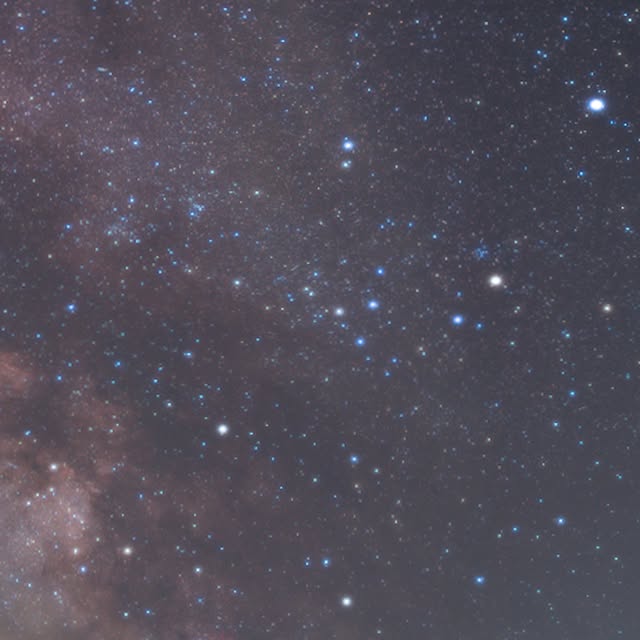
Night-sky images need dark walls or good light
A dark image on a bright white wall under a window loses its shadows. These frames live best on a mid or dark wall, or with a light source that is not fighting them. It is worth thinking about before choosing where it goes.
03
Paper changes the image more than you expect
A matte cotton rag holds shadow separation and reads quietly. A lustre or metallic surface pushes contrast and makes stars punch. Neither is correct; they suit different rooms and different images.
04
Glass matters for dark prints
Standard glazing on a dark astro image behaves like a mirror. Museum or anti-reflective glazing costs more and is the single biggest upgrade to how a night-sky print actually looks on a wall.
Archive
Other frames that would print well.
Not everything in the archive is listed for sale. If a particular frame belongs on your wall, ask. Print requests from the archive are handled individually rather than through a catalogue.
Hotels, offices, restaurants and residential projects sometimes need a coordinated set rather than a single frame: consistent tone across a corridor, a specific palette, a particular scale, or images tied to a place the property actually sits in.
That is a licensing and production conversation rather than a storefront purchase, and it is usually more interesting than either.